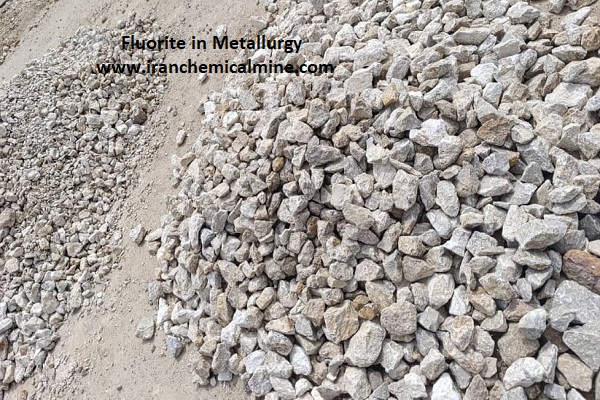
Fluorite In Metallurgy
Fluorite in Metallurgy or using fluorspar in metal making, is sometimes used as a flux with lime to improve the fluidity of slag in steel making and ladle metallurgy. Fluorine promotes the fluidity of slag (by lowering its melting point) and thus enables the removal of sulfur and phosphorus from the steel into the slag. Fluorspar is used in steel making at 2 to 10 kg or 5 to 10% of the added lime. Fluorite is used in the treatment of electrolytic slag at a ratio of 70 to 30 fluorspar to lime.
The objective in electrolytic slag treatment is to form a highly conductive slag with the required melting temperature. In aluminum smelting, about 23 kg of AlF3 equivalent is used per ton of aluminum. Fluorite serves similar purposes in iron foundries, where it is added to the blast furnace charge at a rate of about 7-9 kg/ton of molten metal.
Fluorite in metallurgy as slag forming flux
Fluorite in metallurgy is used as a slag-forming material with a low melting point in the metallurgical industry. This material has a cubic crystal system, a hardness of 4 Mohs, a specific gravity of 3.18 g / cm3 and a melting point of 1330 ° C. The color of this raw material also varies depending on the amount of impurity elements in the crystal lattice. In the field of trade and sales, fluorine can be divided into three categories.
1. Fluorine used in the acid industry
2. Fluorite in metallurgy used in the chemical industry
3. Fluorite in metallurgy used in the metallurgical industry Fluorine with a content of 60 to 85% CaF2, which is defined as metallurgical grade, is used in steel making and ladle metallurgical processes as a fluxing agent to reduce the surface pressure of the slag, reduce the melting temperature and viscosity of the slag (improve the fluidity of the slag) and enable the removal of iron, sulfur and phosphorus from the steel into the slag.
Metallurgical flux is a compound that combines with gangue (waste minerals) in ores during smelting and with impurities in molten metal during metal refining. And forms a slag that has a low density and is immersible with molten metal.
The chemical properties of slags are adjusted to provide the appropriate melting temperature, viscosity, surface tension, conductivity, specific heat and density in a particular metallurgical process, one of the factors regulating the chemical properties of slag is the consumption of this substance (fluorine).