
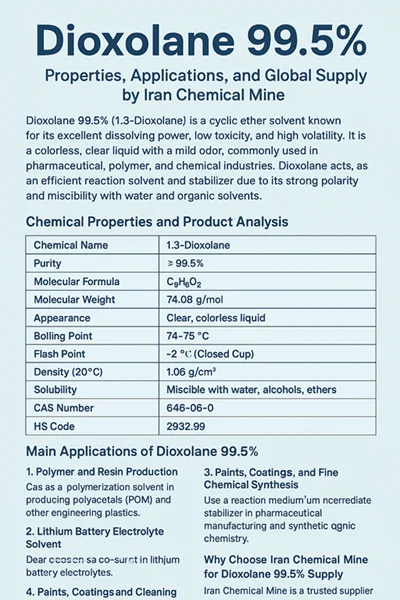
Dioxolane
What is Dioxolane?
Dioxolane or 1,3-Dioxalane, a cyclic acetal with the chemical formula C3H6O2 and PubChem ID 12586, is a clear, colorless liquid with a mild, ether-like odor. Dioxalane has a flash point of 32 degrees Fahrenheit and a density of 1.06 grams per cubic centimeter, and its vapor is heavier than air.
Structurally, this compound is a cyclic acetal of pentane in which the carbon atoms at positions 1 and 3 are replaced by oxygen atoms, respectively. Dioxalane is miscible with water, ethanol, ether, and acetone.
Dioxalane Application
The following are some of the uses of 1,3-dioxalane:
- Use as a solvent and low-boiling extractant for oils, fats, waxes, dyes, and cellulose derivative
Use in the production of adhesives and sealants as a solvent - Use in the production of phenolic and novolac resins as a crosslinking agent
- Comonomer for the production of polyesters and other polymers.for chemical reactions including inorganic salts
- Stabilizer for halogenated organic solvents and use as a starting material or reagent for organic synthesis.
- Production of plastic composites
- Production of plastic packaging and equipment such as cups, plates, and food storage containers Battery industry Dixalane can also be a good alternative to the solvents MEK (methyl ethyl ketone), THF (tetrahydrofuran), NMP (normal methyl pyrrolidone) in industry.
Dioxalane Industrial production
First production process 1,4-Dioxalane is produced in a closed system by acid-catalyzed conversion of diethylene glycol through dehydration and ring closure. Mono-, tri- and polyethylene glycols and their ethers are used as raw materials and concentrated sulfuric acid (about 5%) is used as the acid catalyst.
Phosphoric acid, ion exchange resins and zeolites are alternatives and the operating conditions are different. The pressure varies from partial vacuum to low pressure and the ideal temperature is 160 ° C. The reaction process is carried out continuously in a heated vessel. The crude product 1,4-dioxalane forms an azeotrope with water, which is evaporated from the reaction vessel by distillation.
The vapors of 1,4-dioxane are passed through an acid and two distillation columns to remove water and purify the product. 2-Methyl-3-1-dioxalane, 2-ethyl-3-1-dioxalane and acetaldehyde are by-products and to a lesser extent, crotonaldehyde and polyglycol are formed during production.
Second production process 4-1-dioxane was prepared by ring-closing 2-chloro-2-hydroxydiethyl ether (formed by the reaction of ethylene glycol with 1,2-dibromoethane) by heating with 20% sodium hydroxide and catalyzed cyclodimerization of ethylene.
What can dioxolane replace?
Due to its solvent properties and chemical stability, dioxolane can replace several substances in various applications. Here are some substances that dioxolane can replace:
1. Tetrahydrofuran (THF):
Dioxolane can be used as a replacement for THF in polymerization reactions and as a solvent in organic synthesis.
2. Dimethyl sulfoxide (DMSO):
In some cases, dioxolane can replace DMSO as a solvent, especially in reactions where a less polar solvent is needed.
3. Acetonitrile:
For certain chromatography and extraction processes, dioxolane can be used in place of acetonitrile.
4. Ethyl acetate:
Dioxolane can serve as a replacement for ethyl acetate in various solvent applications, especially where a more stable solvent is needed.
5. Methanol:
In certain chemical reactions, dioxolane can be substituted for methanol, especially when a less reactive solvent is preferred.
6. 1,4-Dioxane:
Dioxolane can be used in place of 1,4-dioxane in some applications, although it is generally considered safer and less toxic.
Chemical Properties and Product Analysis
| Parameter | Specification |
|---|---|
| Chemical Name | 1,3-Dioxolane |
| Purity | ≥ 99.5% |
| Molecular Formula | C₃H₆O₂ |
| Molecular Weight | 74.08 g/mol |
| Appearance | Clear, colorless liquid |
| Boiling Point | 74–75 °C |
| Flash Point | -2 °C (Closed Cup) |
| Density (20°C) | 1.06 g/cm³ |
| Solubility | Miscible with water, alcohols, ethers |
| CAS Number | 646-06-0 |
| HS Code | 2932.99 |
