
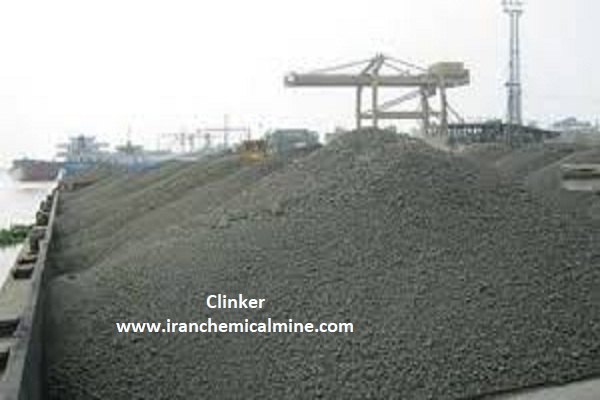
Clinker
Clinker is a raw material used to produce cement.Some cement production plants purchase clinker directly due to lack of access to sufficient raw materials; But some other plants that have sufficient access to raw materials usually complete the cement production cycle.
Clinker Properties
Clinker has the appearance of round grains whose diameter usually varies between 3 and 25 mm. This material is obtained in the process of calcining the raw materials used in cement production. Raw materials are clay and limestone, which are heated in a kiln at a temperature of 1400 to 1500 degrees Celsius. At this temperature, the raw materials become liquid;
But before the complete phase change, they are suddenly removed from the kiln and cooled rapidly. In this way, the raw materials become lumpy and are obtained in different sizes. The products of the kilning process in cement production are called clinker.
This material has a high shelf life and if it is stored in a dry and moisture-free environment, it can be used for cement production for a long time. This is why cement factories, in conditions of shortage of raw materials, go directly to purchase this raw material.
Clinker Composition
There are two general approaches to identifying the components of this material. The first approach is related to mineralogy, which uses petrographic microscopy and X-ray diffraction analysis for this purpose.
As a result of mineralogical analysis, it is determined that four main components can be considered as the composition:
1- Alite or tricalcium silicate: about 65% of the total
2- Belite or dicalcium silicate: about 15% of the total
3- Aluminate or tricalcium aluminate: about 7% of the total Ferrite
or tetracalcium aluminoferrite: about 8% of the total In addition to the above four components, a small percentage of other compounds may also be found in that, which vary depending on the type of clay and limestone.
Another approach is related to the chemical analysis. In this case, using the oxidation, its constituent elements are identified, which are:
Silicon oxide (SiO2): 21.5 percent
Aluminum oxide (Al2O3): 5.2 percent
Iron oxide (Fe2O3): 2.8 percent
Calcium oxide (CaO): 66.6 percent
Magnesium oxide (MgO): 1 percent
Potassium oxide (K2O): 0.6 percent Sodium oxide (Na2O): 0.2 percent
Sulfur trioxide (SO3): 1 percent
In the chemical analysis, we may also find other substances such as titanium oxide, manganese, phosphorus and chromium. These substances are usually added to balance the physical and chemical properties during the production process.
Clinker Types
Sulfate-resistant
Low-temperature
White clinker Low-alkali
