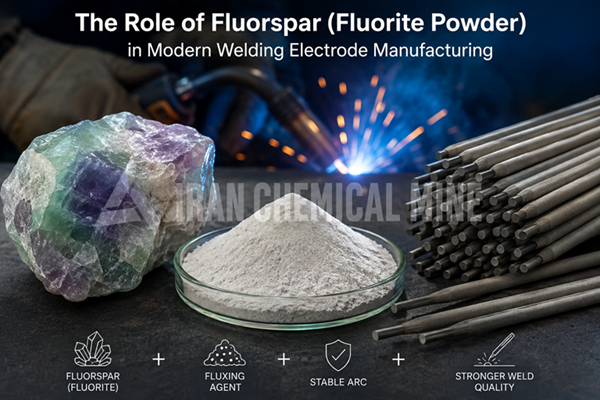
The Role of Fluorspar (Fluorite Powder) in Modern Welding Electrode Manufacturing
In electric arc welding, electrode coating quality determines joint strength, arc stability, and bead appearance. Among flux coating minerals, fluorspar (calcium fluoride, CaF2) plays a crucial role in performance.
Welding electrode manufacturers use specific grades of fluorine powder to refine metal deposits, reduce diffusible hydrogen, and manage slag fluidity during operation.
1. What Is Fluorspar Powder in Welding Applications?
Fluorspar (also known as fluorite) is a halide mineral composed of calcium fluoride (CaF2). When finely ground into a consistent mesh powder, it becomes an essential dry ingredient in flux formulations for basic (low-hydrogen), stainless steel, and flux-cored arc welding (FCAW) wires.
                 [ Fluorspar Powder (CaF2) ]
                             │
     ┌───────────────────────┼───────────────────────┐
     ▼                       ▼                       ▼
Metallurgical Flux      Metallurgical Slag       Shielding Gas
(Lowers Melting Point)  (Reduces Viscosity)    (Suppresses Hydrogen)
In the welding arc, fluorspar decomposes and reacts at high temperatures, functioning as a slag viscosity modifier, deoxidizer, and arc stabilizer.
2. Key Benefits of Fluorspar in Electrode Coating
Deoxidation and Chemical Refining
During manual metal arc (MMA) welding, molten steel absorbs oxygen, nitrogen, and hydrogen from surrounding air. Fluorite reacts with impurities to form stable compounds, capturing non-metallic inclusions and transferring them into the floating slag layer rather than the weld deposit.
Slag Fluidity and Freezing Control
Pure lime (CaO) or silica (SiO2) slag systems melt at extremely high temperatures and can become sluggish. Fluorspar significantly lowers the melting point of slag and thins it out. This creates a fast-freezing slag layer ideal for out-of-position welding (vertical and overhead) while ensuring clean slag removal after cooling.
Hydrogen Control and Crack Prevention
Hydrogen embrittlement is a primary cause of cold cracking in high-strength carbon steels. CaF2 reacts with hydrogen in the arc zone to form hydrogen fluoride (HF), an insoluble gas that escapes into the atmosphere rather than dissolving into the molten pool:
CaF2 + H2O =CaO + 2HF
This reaction lowers diffusible hydrogen levels, making fluorspar critical for AWS E7018 and other low-hydrogen basic electrodes.
3. Chemical Analysis & Technical Specifications
Welding electrode manufacturers require strict control over chemical purity. High levels of sulfur or phosphorus cause hot shortness and cracking in welds, while excess moisture leads to porosity.
Standard Ceramic/Welding Grade Fluorspar Specifications
| Chemical / Physical Parameter | Typical Industrial Specification | Iran Chemical Mine Premium Grade |
| Calcium Fluoride (CaF2) | 92.0% – 95.0% | 95.5% – 97.0% |
| Silica (SiO2) | 2.5% – 4.0% | 1.8% |
| Calcium Carbonate (CaCO3) | 1.5% – 3.0% | 1.2% |
| Sulfur (S) | 0.03% | 0.015% |
| Phosphorus (P) | 0.03% | 0.02% |
| Ferric Oxide (Fe2O3) | 0.2% – 0.5% | 0.15% |
| Moisture Content | 0.5% | 0.2% |
| Particle Size (Mesh) | 100 mesh to 325 mesh | Custom mesh (100–325 mesh) |
4. Comparing Flux Formulations: Rutile vs. Basic Electrodes
The table below illustrates how flux coatings differ and why fluorspar is central to basic low-hydrogen formulations:
| Property / Feature | Basic Low-Hydrogen Electrodes (E7018) | Rutile Electrodes (E6013) | Cellulose Electrodes (E6010) |
| Primary Flux Base | Calcium Carbonate (CaCO3) + Fluorspar (CaF2) | Titanium Dioxide (TiO2) | Cellulose Wood Pulp |
| Fluorspar Content | High (15% – 30%) | Very Low (0% – 5%) | Minimal |
| Diffusible Hydrogen | Very Low (< 4 ml/100) | Moderate to High | High |
| Mechanical Toughness | Excellent (High Impact Resistance) | Moderate | Moderate |
| Arc Characteristics | Stiff, short arc; requires clean base metal | Soft, smooth; low spatter | Deep penetration, forceful arc |
| Primary Applications | Pressure vessels, structural steel, heavy machinery | Light fabrication, sheet metal | Pipeline root passes |
5. Market Demand, Regional Outlook, and Export Destinations
Global Demand Drivers
Demand for industrial-grade fluorspar powder in welding is driven by global investments in energy, shipbuilding, heavy infrastructure, and pipeline construction. As high-strength low-alloy (HSLA) steels become standard in construction, basic electrodes and flux-cored wires containing fluorspar see steady consumption growth.
Strategic Export Destinations
Key importing regions for high-purity fluorspar powder include:
- Middle East & GCC Region: Offshore oil and gas structures, refinery expansion, and infrastructure.
- Central Asia & CIS Countries: Heavy manufacturing, mining equipment, and cross-country pipelines.
- South & Southeast Asia: Expanding shipbuilding industries, industrial parks, and bridge construction.
- East Europe: Automotive component supply chains and industrial structural steel fabricators.
6. Packaging Options and Quality Control
To maintain low diffusible hydrogen properties, fluorspar powder must be protected against ambient humidity during shipping and storage.
┌─────────────────────────────────────────────────────────────┐
│                 IRAN CHEMICAL MINE PACKAGING                 │
├──────────────────────────────┬──────────────────────────────┤
│ 25 kg / 50 kg Paper Bags     │ 1,000 kg Jumbo Bags          │
│ • Moisture-proof PE liner    │ • Heavy-duty woven PP        │
│ • Shrink-wrapped on pallets  │ • Bottom spout discharge     │
└──────────────────────────────┴──────────────────────────────┘
- Standard Multi-Wall Paper Bags: 25 kg or 50 kg net weight with an inner polyethylene (PE) layer to block humidity.
- Jumbo Big Bags (FIBC): 1,000 kg to 1,250 kg UV-stabilized polypropylene bags with bottom discharge spouts, ideal for automated electrode coating lines.
- Palletization: Palletized, strapped, and shrink-wrapped for safe ocean and overland transport.
7. Why Source Fluorspar from Iran Chemical Mine?
Selecting a reliable industrial mineral supplier ensures consistent flux batch performance, minimal rejections, and stable production runs. Iran Chemical Mine provides:
- Consistent Purity: Selective mining and processing maintain high CaF2 content while keeping sulfur, phosphorus, and iron limits strictly within technical parameters.
- Custom Particle Sizing: Air-classified milling capabilities supply tailored particle size distributions (100 to 325 mesh) for consistent dry-mixing and extrusion.
- Controlled Moisture Levels: Processing lines use thermal drying and sealed packaging to ensure zero moisture contamination before use.
- Supply Chain Reliability: Direct quarry ownership and integrated logistics provide competitive pricing and dependable delivery schedules to global export markets.