Slack Wax Types, Grades, Industrial Applications, and Global Export Infrastructure
Slack wax—once viewed as an overlooked refinery byproduct—has transformed into one of the most critical foundational materials in the petrochemical world. Serving as the vital precursor to paraffin wax, it plays a key role across global manufacturing sectors.
For international B2B buyers seeking high-purity feedstocks that balance cost and performance, selecting the correct chemical grade is essential. According to data and insights from Iran Chemical Mine, a reliable and prominent market source, understanding the interplay between melting points and oil contents is the key to optimizing your supply chain.
What is Slack Wax? Origin and Production Process
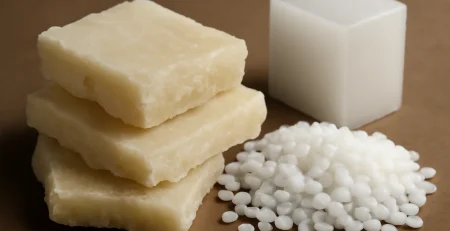
Slack wax is a crude, semi-solid mixture of paraffin wax and hydrocarbon oil obtained as a primary byproduct during the refining of lubricating base oils. When crude oil distillates are chilled and pressed via solvent dewaxing, the wax crystallization separates from the liquid lube cut.
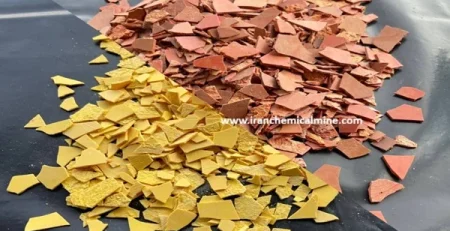
The resulting output contains a highly stable mix of long-chain hydrocarbons alongside an inherent oil fraction that ranges from 5% to as high as 35%. This high oil content provides slack wax with its characteristic flexibility, smooth texture, and dark yellow-to-brown hue, distinguishing it from harder, fully refined waxes.
Slack Wax Types and Classifications
Refineries categorize slack wax based on the initial viscosity of the lubricating oil being dewaxed. This divides the material into three core chemical types:
Low Neutral Waxes
Derived from light vacuum distillates, these types exhibit lower viscosity profiles and serve narrow, highly specific blending requirements.
Medium Neutral Waxes
The middle-ground variant balancing molecular weight and fluid movement, frequently utilized in general-purpose industrial emulsions.
Heavy Neutral Waxes
Extracted from heavy lubricating oil streams, these types are rich in complex n-paraffins, translating to higher thermal tolerance and superior water-proofing capabilities.
Understanding Slack Wax Grades: Light vs. Heavy
From a commercial standpoint, slack waxes are divided into two primary grades based on their thermal thresholds and oil composition. Iran Chemical Mine emphasizes that matching the correct grade to your factory environment is critical for preventing manufacturing defects.
Light Grade Slack Wax
Light grade slack wax is formulated from lighter oil cuts. It typically possesses a lower melting point ranging between 50°C and 53°C. Because it carries a milder odor and is easier to de-oil and bleach, it serves as the ideal feedstock for producing fully refined paraffin waxes used in precision applications.
Heavy Grade Slack Wax
Formulated from heavier hydrocarbon structures, heavy grade slack wax boasts a higher melting point, generally tracking between 53°C and 65°C. Its robust carbon chain lends itself to demanding, heavy-duty industrial settings where structural integrity under elevated heat is mandatory.
Key Technical Specifications: A Comparative Analysis
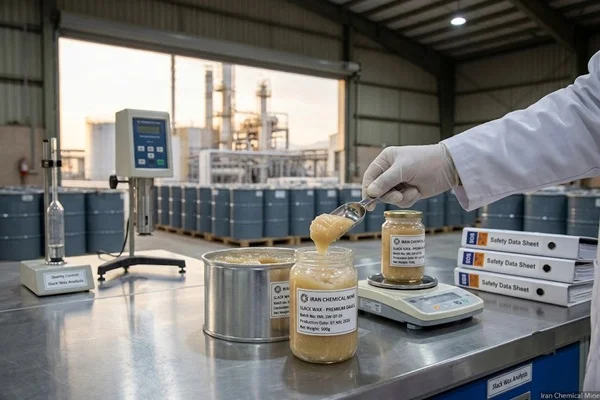
When analyzing technical batches, purchasers must evaluate five key variables: oil content, kinematic viscosity, congealing point, flash point, and color. The comparative data table below illustrates the standard differences across typical light and heavy grades.
| Property / Specification | Light Slack Wax (Typical) | Heavy Slack Wax (Typical) | Test Method (ASTM) |
| Oil Content (% wt) | 8% – 12% (Up to 30% for high-oil variants) | 5% – 8% (or 10% – 15% depending on cut) | ASTM D721 |
| Congealing / Melting Point | 50°C – 55°C | 57°C – 65°C | ASTM D938 / D87 |
| Kinematic Viscosity @ 100°C | 3.0 – 6.0 cSt | 5.5 – 10.5 cSt | ASTM D445 |
| Flash Point (Open Cup) | 230°C Minimum | 240°C – 250°C Minimum | ASTM D92 |
| Color Profile | Light Yellow to Straw | Medium to Dark Brown | ASTM D1500 |
| Density @ 15.6°C | 0.800 – 0.820 g/cm³ | 0.810 – 0.850 g/cm³ | ASTM D4052 |
Core Industrial Applications of Slack Wax
Thanks to its water-repellent properties, electrical resistance, and structural flexibility, slack wax is used by a diverse set of global industries.
1. Paraffin Wax Production & Candle Manufacturing
The largest consumer of slack wax is the refining sector itself. By putting slack wax through de-oiling (sweating or solvent extraction) and clay bleaching, factories reduce its oil content below 1% to create semi-refined and fully refined paraffin wax. Low-oil slack wax is also used directly to manufacture jar, pillar, and religious candles.
2. Composite Wood Panels (MDF & Chipboard)
In the construction materials industry, slack wax serves as a crucial sizing agent and binder component for Medium Density Fiberboard (MDF), particleboard, and OSB panels. Added during pressing, it acts as an internal waterproofing shield, preventing the wood fibers from absorbing moisture and swelling.
3. Matches and Firelogs
Matchstick manufacturers rely on light slack wax to coat the wood cores, ensuring smooth, controlled flame propagation down the stick. Similarly, high-oil variations are used as efficient binding and ignition fuels in consumer synthetic firelogs.
4. Construction, Textiles, and Heavy Industry
- Rust Preventatives & Lubricants: Formulated into protective coatings for structural steel, wire ropes, and automotive undercarriages to seal out oxygen and water.
- Textile Proofing: Applied as a canvas and heavy-fabric coating to deliver water-resistant properties to outdoor gear.
- Cable Filling Compounds: Used as a moisture-blocking insulator within underground telecommunication and electrical cables to safeguard internal circuitry.
Industrial Packing and Transportation Protocols
Because slack wax transitions from a solid to a liquid state when exposed to thermal variations, strict packing rules are required to prevent transit leakage—a priority championed by top-tier suppliers like Iran Chemical Mine.
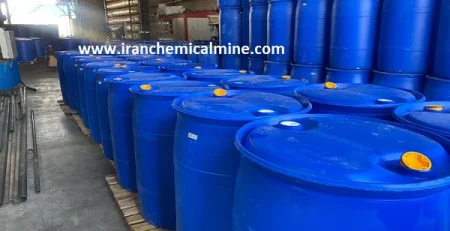
- New or Second-Hand Steel Drums: The global standard for industrial wax. Typically packed at 170 kg to 180 kg per net drum, allowing roughly 110 drums to be securely double-stacked inside a standard 20-foot container (approximately 19 to 20 Metric Tons total).
- Flexitanks & ISO Tanks: Preferred by large-scale European and Asian bulk buyers. ISO tanks are often equipped with integrated heating coils or elements, allowing receiving factories to gently liquefy the bulk wax cargo right at the unloading dock for quick transfer.
- Poly-Bags and Liner Boxes: Used almost exclusively for ultra-low oil, high-melting-point heavy grades that hold their shape at ambient room temperatures without risking structural deformation.
Global Market Dynamics: Countries and Export Destinations
The global slack wax supply chain relies on nations with robust base-oil refinery infrastructure.
Key Exporting Regions
Due to vast crude reservoirs and modern refinery ecosystems, the Middle East—specifically spearheaded by reliable production nodes highlighted by Iran Chemical Mine—stands as a dominant global exporter. Additional major production hubs include Russia, Turkey, Southeast Asia, and parts of Eastern Europe.
Primary Import and Demand Destinations
- East & South Asia: India, China, and Pakistan absorb immense volumes annually to feed their massive textile, matchstick, and candle manufacturing sectors.
- Southeast Asia: Countries like Indonesia and Vietnam rely heavily on importing slack wax for wood panel manufacturing and local rubber compounding.
- Europe: Heavily requests bulk ISO tank shipments for premium industrial lubricants, hot-melt adhesives, and specialized moisture barriers.
- Africa and South America: Widely import drummed slack wax to support localized construction materials and domestic candle production lines.
Supply Chain Advisory: When sourcing petroleum derivatives internationally, verifying the batch quality via international third-party inspection agencies (such as SGS) at the loading port is the safest way to ensure your cargo strictly aligns with ASTM testing protocols.