Ferro Tungsten Production, Industrial Applications, and Global Export Markets
The rapid advancement of global heavy industries, aerospace technology, and precision manufacturing requires raw materials that can withstand absolute mechanical and thermal extremes. Among these critical materials, Ferro Tungsten (FeW) stands out as an indispensable master alloy.
At IranChemicalMine, we bridge the gap between world-class mining extractions and global industrial demand. This article provides a deep dive into the engineering properties, production processes, core benefits, and international market dynamics of Ferro Tungsten.
What is Ferro Tungsten? An Overview of the Master Alloy
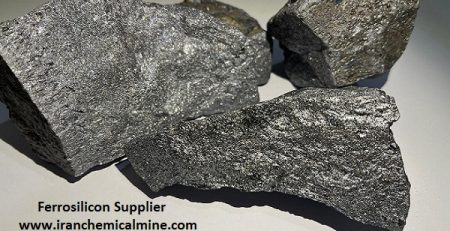
Ferro Tungsten is a robust ferroalloy composed primarily of iron (Fe) and tungsten (W). Typically containing between 70% to 85% tungsten by weight, this master alloy features a distinct steel-grey metallic luster, a fine-grained molecular structure (Fe2W and Fe7W6), and an exceptionally high density ranging from 14 to 15.5 gr/cm3.
Because tungsten possesses the highest melting point of all metallic elements (3,422 C), combining it with iron yields a dense, high-melting-point alloy (2,400 to 2,800 C). This makes it exceptionally efficient for introduction into molten steel matrices during heavy metallurgical processing.
The Production Process of Ferro Tungsten
The manufacturing of high-grade Ferro Tungsten requires complex pyrometallurgical reduction processes. The primary raw materials utilized are rich tungsten mineral concentrates, namely Wolframite and Scheelite.
Industrial refineries predominantly utilize two primary chemical production methods:
1. Carbothermic Reduction in Electric Arc Furnaces (EAF)
This is the most common commercial method for producing premium-grade FeW:
- Tungsten ore concentrates are mixed with a carbon reducing agent (such as coke or anthracite) and iron ore/scrap.
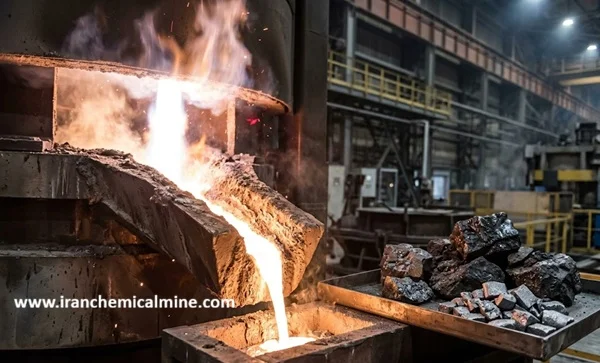
- The mixture is charged into an intensive Electric Arc Furnace capable of generating temperatures exceeding 3,000 C.
- The carbon strips oxygen away from the tungsten oxides, leaving behind a highly concentrated molten layer of Ferro Tungsten beneath a layer of refining slag.
2. Aluminothermic or Silicothermic Reduction
For specialized applications requiring very low carbon contents, aluminothermic or silicothermic reduction is used:
- Aluminum powder or ferrosilicon is used as the reducing agent instead of carbon.
- The chemical reaction is highly exothermic, generating its own heat to fuse the iron and tungsten molecules cleanly, yielding high-purity variants (such as 3N to 5N purity scales).
Primary Industrial Applications of Ferro Tungsten
More than half of the world’s Ferro Tungsten consumption is dedicated to the production of specialized alloy steels. Its unique chemical architecture modifies steel at a molecular level, finding essential uses across several major sectors:
1. High-Speed Steel (HSS) and Tool Manufacturing
Ferro Tungsten acts as the core additive in High-Speed Steel (HSS), accounting for over 52% of total global consumption. HSS is widely used to manufacture drills, milling cutters, saw blades, punches, and heavy-duty dies. The addition of tungsten preserves the tool’s sharpness and structural integrity even under high friction and mechanical loads.
2. Aerospace, Defense, and Superalloys
In the aerospace sector, safety and heat resistance are paramount. FeW is utilized in formulating superalloys for:
- Aircraft turbine blades and exhaust nozzles.
- Rocket engine components and missile guidance casings.
- Military armor-piercing projectiles and heavy ballistic shielding.
3. Castings and Welding Electrodes
In heavy foundry environments, Ferro Tungsten is added to casting melts to improve wear-resistant coatings. Furthermore, it serves as a coating component in high-performance welding electrodes, stabilizing electric arcs and preventing thermal cracking in structural joints.
Key Advantages of Utilizing Ferro Tungsten in Metallurgy
Why do global steel producers choose Ferro Tungsten over alternative elemental additives? The key benefits can be broken down into three crucial metallurgical improvements:
- Unmatched “Red Hardness”: “Red hardness” refers to a metal’s ability to retain its hardness and cutting efficiency even when heated to a dull red glow (600 C). FeW stops steel from softening during high-speed machining operations.
- Superior Thermal Creep Resistance: Under continuous mechanical load and high temperatures, standard metals suffer from structural deformation (creep). Ferro Tungsten locks structural grains together, maximizing creep resistance.
- Excellent Corrosion and Wear Resistance: The chemical stability of tungsten creates an atomic barrier that heavily reduces oxidization and abrasive wear in harsh chemical or oceanic environments.
Comparative Analysis: Ferro Tungsten vs. Alternative Raw Materials
To understand the strategic value of Ferro Tungsten, it is helpful to evaluate how it compares to other common alloying agents used across heavy industries:
| Industry Sector | Ferro Tungsten (FeW) | Ferro Molybdenum (FeMo) | Ferro Niobium (FeNb) |
| Primary Property Imparted | Extreme Red Hardness & Thermal Creep Resistance | Toughness & Pitting Corrosion Resistance | Grain Refinement & High-Yield Strength |
| Melting Point Profile | Ultra-High (2400 to 2800C) | High (app. 1900 C) | Medium-High (app. 1600C) |
| Typical Industry Target | High-Speed Cutting Tools, Rocket Components, Aerospace | Automotive Parts, Oil & Gas Pipelines, Stainless Steel | Structural Infrastructure Steels, Oil Pipelines |
| Wear Resistance Rating | Outstanding (Highest Tool Life) | Moderate to High | Moderate |
Global Market Dynamics and Export Destinations
The global Ferro Tungsten market is heavily tied to international infrastructure cycles and defense manufacturing. Because tungsten ore deposits are concentrated in specific geographic zones, the supply chain for FeW is highly specialized.
Major Producing Nations
- China: Holds the dominant position, accounting for roughly 60% to 65% of global extraction and downstream ferroalloy processing.
- Vietnam & Russia: Act as primary secondary producers, securing significant supply lines for non-Chinese supply chains.
Key Global Export Destinations
The main import markets for premium-grade Ferro Tungsten are advanced industrial economies with large automotive, aerospace, and precision engineering sectors:
- Europe: Led by Germany, Italy, and the United Kingdom for aerospace manufacturing and precision machining tool fabrication.
- Asia-Pacific: Led by South Korea, Japan, and India. India represents a fast-growing import destination due to expanding defense and automotive manufacturing infrastructure.
- North America: The United States remains a massive consumer of high-purity (4N and 5N grade) Ferro Tungsten for its commercial aviation and military aerospace supply lines.
Partner with IranChemicalMine for Your Industrial Sourcing
As heavy manufacturing evolves, securing a stable supply of high-melting-point ferroalloys is crucial for maintaining a competitive edge. Ferro Tungsten remains an essential component for high-performance metallurgy, offering distinct advantages in wear resistance, thermal stability, and cutting strength.
At IranChemicalMine, we supply premium industrial minerals and master alloys tailored to strict international criteria. Contact our global procurement desk today to get custom technical data sheets, updated market quotes, and reliable logistics planning for your production lines.
Ferro Alloys, Tungsten Concentrate, Steelmaking Raw Materials, Industrial Minerals Supply, IranChemicalMine Products.