Premium Alcohol 96%: A Comprehensive Guide to Applications, MSDS Safety, and Global Distribution
Introduction to Premium Alcohol 96% (Ethanol)
Alcohol 96% commonly referred to as rectified spirit, high-purity ethanol (C2H5OH), or agricultural ethyl alcohol is a foundational solvent across the modern global manufacturing landscape. Reaching an optimal 96% volume concentration, this chemical forms a natural azeotrope with water, representing the highest concentration achievable through conventional, ultra-efficient fractional distillation.
For high-tier industries such as food processing, cosmetics formulation, and pharmaceuticals, the chemical’s origin matters. When sourced through premium suppliers like Iran Chemical Mine, Alcohol 96% is derived primarily from agricultural fermentation (such as sugar molasses or grains) rather than synthetic petroleum tracking. This ensures a non-denatured, exceptionally pure fluid containing negligible trace levels of methanol, aldehydes, and higher alcohols.
Key Characteristics and Chemical Properties
Understanding the basic physical and chemical parameters of high-purity ethanol is essential for formulating safe, compliant downstream products.
Core Chemical Data
- Chemical Formula: C2H5OH
- Appearance: Clear, completely colorless, volatile liquid.
- Odor: Characteristic pleasant, mild, alcoholic aroma.
- Boiling Point: Approximately 78.3°C (172.9°F) at standard atmospheric pressure.
- Flash Point: ~13°C (55.4°F) in closed cup conditions, designating it as a Class 3 Flammable Liquid.
Azeotropic Stability
At 95.6% ethanol and 4.4% water by weight, the mixture boils at a constant temperature and maintains an identical vapor composition to its liquid phase. This stability prevents further concentration via straightforward distillation, rendering Alcohol 96% a reliable, predictable baseline chemical for automated factory inputs.
Industrial Comparison Matrix
Different sectors require varied proofing, baseline purity metrics, and denaturing conditions. The following table highlights how food- and cosmetic-grade Alcohol 96% matches against other common industry variants:
| Parameter / Feature | Food & Cosmetic Grade Alcohol 96% | Absolute Alcohol (99.9%) | Industrial Denatured Alcohol (IDA) |
| Ethanol Content (v/v) | 95.6% – 96.5% | 99.5% – 99.9% | 90.0% – 95.0% |
| Moisture / Water Content | ~4.0% | Less than 0.5% | 5.0% – 10.0% |
| Methanol Limits | < 10 ppm (Ultra Safe) | < 50 ppm | Elevated (Intentionally spiked) |
| Denaturants Added | None (Undenatured) | Variable | Pyridine, Wood Naphtha, or MEK |
| Primary Base Feedstock | Agricultural Fermentation | Synthetic or Dehydrated Ag | Petrochemical Derived |
| Target Industries | Food, Cosmetics, Organics | Fine Labs, Electronics | Paints, Fuel Brines, Coatings |
Major Applications and Benefits by Grade
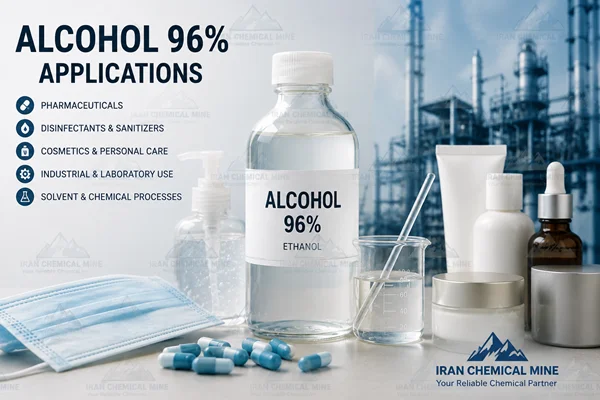
Because it offers an optimal balance of structural volatility and safe residual behavior, this high-purity solvent is vital to consumer product safety.
1. Food Grade Applications
In food manufacturing, Alcohol 96% must conform to strict Food Chemicals Codex (FCC) standards. It functions as a neutral extraction carrier for natural flavors, botanical essences, vanilla extracts, and organic colorings. Because it evaporates rapidly without leaving behind chemical footprints or off-flavors, it is widely utilized as a surface sanitizer for high-speed bakery packaging lines and as an antimicrobial processing aid.
2. Cosmetics and Personal Care Grade Benefits
Premium cosmetic lines rely heavily on undenatured Alcohol 96% as a primary delivery vehicle. It cleanly dissolves high-value essential oils, fragrance profiles, and synthetic fixatives in luxury perfumes, colognes, and body mists. In skincare formulations, it provides an instantaneous cooling effect upon skin contact, promotes rapid drying in hairsprays, and acts as an astringent and clarifying agent in facial toners.
3. Pharmaceutical and Sanitization Baselines
Beyond consumer goods, this grade matches strict United States Pharmacopeia (USP) and European Pharmacopoeia (EP) benchmarks. It serves as a sterile base for surgical scrubs, antiseptic hand gels, hospital-grade surface wipes, and as an extraction agent for producing active pharmaceutical ingredients (APIs) and therapeutic herbal tinctures.
MSDS Summary and Precautionary Handling Guide
Due to its high volatility and volatile vapor profile, handling Alcohol 96% demands unwavering adherence to standardized safety frameworks.
Material Safety Data Sheet (MSDS) Core Hazards
According to the standardized MSDS, high-purity ethanol is classified as a Category 2 Flammable Liquid and a Category 2A Eye Irritant. Its vapors can travel along floor surfaces to distant ignition sources and flash back rapidly.
Crucial MSDS Warning: Vapors can form explosive mixtures with air at room temperature. Proper grounding, localized explosion-proof ventilation, and ignition-free storage environments are legally mandatory.
Essential Precautionary Handling Guidelines
- Ignition Control: Eliminate all open flames, hot surfaces, electrical sparks, and smoking zones within handling or storage bays. Use non-sparking hand tools.
- Static Mitigation: Ensure all storage tanks, piping systems, and bulk transport pumps are thoroughly bonded and grounded to dissipate static electricity during high-speed transfer cycles.
- Personal Protective Equipment (PPE): Workers must wear chemical splash goggles, face shields, anti-static protective clothing, and nitrile or neoprene chemical-resistant gloves.
- First Aid Protocols:
- Inhalation: Move the individual to fresh air immediately. Seek medical attention if breathing issues persist.
- Eye Contact: Flush gently with clean water for at least 15 minutes, removing contact lenses if present. Seek immediate medical review.
- Skin Contact: Wash thoroughly with mild soap and water.
Global Export Destinations and Logistics
Because of its broad utility across the global marketplace, Iran Chemical Mine coordinates comprehensive export and trade pathways across several critical manufacturing hubs:
- Middle East & Neighboring Countries: Iraq, Turkey, Pakistan, and the UAE (supporting large-scale sanitization and cosmetic blending plants).
- CIS and Central Asia: Turkmenistan, Uzbekistan, Kazakhstan, and Azerbaijan (supplying high-volume regional pharmaceutical and consumer goods processors).
- The Caucasus and Eastern Europe: Georgia, Armenia, and Bulgaria (servicing specialized chemical synthesis labs and agricultural extractors).
Why Choose Iran Chemical Mine as Your Supply Source?
Securing a reliable raw material partner requires looking beyond basic price models to verify purity compliance, supply chain continuity, and transport safety. Iran Chemical Mine stands as an authoritative global source for premium Alcohol 96%.
Rigorous Analytical Controls
Every bulk container or specialized transport load managed by Iran Chemical Mine undergoes rigorous gas chromatography (GC-MS) laboratory analysis. We guarantee our clients complete traceability, checking for minimal water, low acidity, and zero unauthorized denaturants to ensure full conformity with international food-grade and cosmetic-grade criteria.
Specialized Logistics Network
To protect product integrity, we utilize advanced logistics handling, deploying clean, dedicated transport facilities and customized storage arrays that prevent atmospheric moisture absorption and external contamination. From independent third-party analysis certifications (such as SGS validation) to transparent customs clearance pathways, Iran Chemical Mine streamlines your raw material procurement from plant to factory floor.