Fluorspar (Fluorite) Grades, Purity, Applications, Specifications and Global Export Markets
Fluorspar, also known as fluorite or calcium fluoride (CaF₂), is one of the most important industrial minerals used as a source of fluorine and as a flux in metallurgical processes. Depending on its purity, chemical composition, particle size and physical form, fluorspar is commercially supplied in several grades, including acid grade fluorspar, ceramic grade fluorspar and metallurgical grade fluorspar.
Fluorspar has applications across the chemical, steel, aluminum, glass, ceramic, welding, cement and fluorochemical industries. High-purity fluorspar is particularly important for producing hydrofluoric acid (HF), which serves as a fundamental feedstock for many fluorine-based chemicals.
Iran Chemical Mine supplies and exports selected grades of fluorspar according to customer requirements, including specifications for CaF₂ content, impurities, particle size and packaging. The company can support international buyers looking for a reliable fluorspar supplier and exporter from Iran.
What Is Fluorspar?
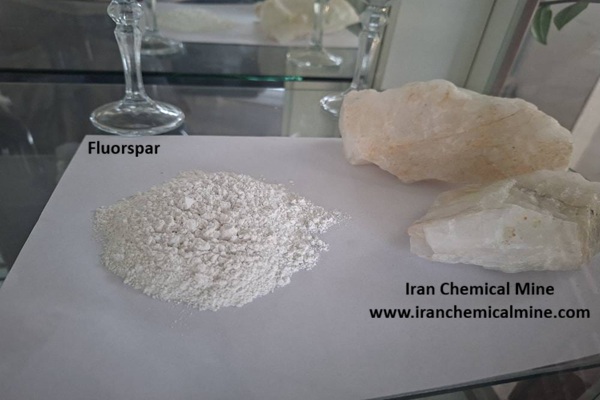
Fluorspar is the commercial name commonly used for naturally occurring fluorite, a mineral composed primarily of calcium fluoride, with the chemical formula CaF₂.
Pure fluorite theoretically contains approximately 51.1% calcium and 48.9% fluorine by mass. Natural fluorspar, however, contains varying amounts of associated minerals and impurities such as silica, calcium carbonate, iron compounds, aluminum compounds, sulfur and other minerals.
The commercial value of fluorspar depends heavily on:
- CaF₂ concentration
- SiO₂ content
- CaCO₃ content
- Fe₂O₃ and other metallic impurities
- sulfur and phosphorus
- moisture
- particle size
- mineralogical characteristics
- consistency between shipments
For this reason, two fluorspar products with the same nominal CaF₂ percentage may have very different commercial values depending on their impurity profile and intended application.
Fluorspar Other Names and Commercial Terminology
Fluorspar is known by several names in the mineral, chemical and international trading industries.
| Name / Term | Meaning / Usage |
|---|---|
| Fluorspar | Common commercial name for industrial fluorite |
| Fluorite | Mineralogical name |
| Calcium Fluoride | Chemical name |
| CaF₂ | Chemical formula |
| Fluorite Powder | Finely ground fluorspar |
| Fluorite Concentrate | Beneficiated material with increased CaF₂ content |
| Acid Spar / Acidspar | High-purity fluorspar, normally >97% CaF₂ |
| Met Spar / Metspar | Metallurgical-grade fluorspar |
| Ceramic Grade Fluorspar | Intermediate-purity grade used in glass, ceramics and enamel |
| Fluorite Concentrate | Processed fluorspar concentrate prepared for industrial applications |
The terms acidspar and metspar are particularly common in international commodity trading.
Fluorspar Grades Based on Purity
Industrial fluorspar is generally classified according to its CaF₂ content and suitability for a specific application.
The three traditional commercial categories are:
- Acid Grade Fluorspar
- Ceramic Grade Fluorspar
- Metallurgical Grade Fluorspar
Specialty and high-purity fluorite products can also be supplied for optical, laboratory and other technically demanding applications.
Acid Grade Fluorspar – High Purity Fluorite
Acid grade fluorspar, also called acidspar, is the highest-volume high-purity industrial grade and generally contains 97% CaF₂ or higher.
Its most important application is the production of hydrofluoric acid (HF). HF is subsequently used to manufacture numerous fluorine-containing products, including fluorochemicals, fluoropolymers, refrigerants and inorganic fluorides.
Because acid-grade fluorspar is processed chemically, impurity control is particularly important.
Typical commercial requirements may include controlled levels of:
- SiO₂
- CaCO₃
- Fe₂O₃
- sulfur
- phosphorus
- moisture
The exact specification varies according to the HF producer and downstream process.
Typical Acid Grade Fluorspar Specification
| Parameter | Typical Commercial Range* |
|---|---|
| CaF₂ | ≥97% |
| SiO₂ | Usually tightly controlled |
| CaCO₃ | Usually tightly controlled |
| Fe₂O₃ | Low |
| Moisture | Controlled |
| Particle size | According to buyer specification |
| Main application | Hydrofluoric acid and fluorochemicals |
*Specifications can vary significantly between buyers. Final values should be established through a mutually agreed technical specification and COA.
According to the U.S. Geological Survey, acid-grade fluorspar is classified as material containing more than 97% CaF₂.
Ceramic Grade Fluorspar
Ceramic-grade fluorspar generally falls in an intermediate CaF₂ range, commonly around 85–96% CaF₂, depending on the producer and application.
This grade is used in:
- glass manufacturing
- enamel production
- ceramic products
- specialty glass
- welding electrode coatings
- certain flux applications
Fluorspar can modify melting behavior and contribute fluorine to the formulation, making it useful in selected glass and ceramic processes.
Typical Ceramic Grade Fluorspar Specification
| Parameter | Typical Range |
|---|---|
| CaF₂ | 85–96% |
| SiO₂ | Controlled according to application |
| CaCO₃ | Controlled |
| Fe₂O₃ | Controlled, particularly for light-colored products |
| Moisture | Controlled |
| Particle size | Fine powder or specified granular size |
| Main applications | Glass, ceramics, enamel, welding |
The 85–96% range is consistent with commonly published industrial classifications for ceramic-grade fluorspar.
Metallurgical Grade Fluorspar
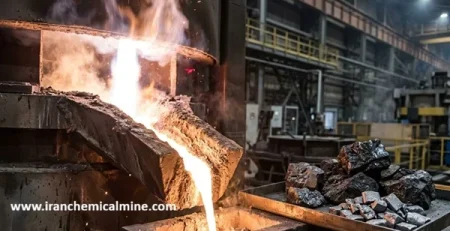
Metallurgical-grade fluorspar, commonly called metspar, is primarily used as a flux in metallurgical processes.
Commercial material can cover a relatively broad CaF₂ range, often approximately 60–85%, although individual purchasing specifications may define higher minimum CaF₂ values.
The principal function of fluorspar in metallurgy is to help control slag properties, particularly by improving slag fluidity and reducing melting temperatures in appropriate processes.
Major applications include:
- steelmaking
- ferroalloy production
- foundries
- aluminum production
- non-ferrous metallurgy
Typical Metallurgical Grade Fluorspar Specification
| Parameter | Typical Commercial Range* |
|---|---|
| CaF₂ | 60–85%+ |
| SiO₂ | Application dependent |
| CaCO₃ | Application dependent |
| Fe₂O₃ | Controlled where required |
| Moisture | Controlled |
| Particle size | Lump, granular or powder |
| Main application | Steelmaking and metallurgy |
*The actual minimum CaF₂ and impurity limits depend on the end user’s process.
Industrial references commonly distinguish metallurgical-grade fluorspar from acid grade based on CaF₂ content and end use.
Fluorspar Grade Comparison
The following table provides a practical comparison of the major industrial grades.
| Grade | Approx. CaF₂ Content | Main Industry | Major Applications | Relative Purity |
|---|---|---|---|---|
| Acid Grade | ≥97% | Chemical | HF, fluorochemicals, fluoropolymers | Very High |
| Ceramic Grade | 85–96% | Glass & Ceramics | Glass, enamel, ceramics, welding | High |
| Metallurgical Grade | 60–85%+ | Metallurgy | Steel, ferroalloys, aluminum, foundry | Medium |
| Specialty / High Purity | 97–99%+ | Specialty industries | Optical, laboratory and technical uses | Very High |
The exact commercial boundary between grades can vary by producer, market and customer specification, so buyers should evaluate the complete COA rather than CaF₂ alone.
Fluorspar Applications by Industry
Fluorspar is important because it is used both as a chemical raw material and as a process flux.
Hydrofluoric Acid Production
One of the most important applications of high-purity fluorspar is the production of hydrofluoric acid.
The simplified reaction is:
CaF₂ + H₂SO₄ → CaSO₄ + 2HF
The resulting HF is an important intermediate for numerous fluorine-based chemicals.
The U.S. Geological Survey identifies hydrofluoric acid as a major downstream use of acid-grade fluorspar.
Fluorochemical Manufacturing
Hydrofluoric acid produced from fluorspar can be further processed into a wide range of fluorine-containing products.
These include:
- refrigerants
- fluoropolymers
- aluminum fluoride
- other inorganic fluorides
- specialty fluorochemicals
- chemical intermediates
Fluorine chemistry is also relevant to industries such as electronics, energy storage, semiconductors and specialty materials.
Steelmaking and Metallurgy
Metallurgical-grade fluorspar is widely used as a fluxing material.
In suitable steelmaking processes, fluorspar can help modify slag properties and improve its fluidity, supporting the separation of impurities from molten metal.
Potential end users include:
- integrated steel mills
- electric arc furnace operations
- ferroalloy producers
- foundries
- non-ferrous metal producers
Aluminum Production
Fluorine compounds derived from fluorspar are important in aluminum metallurgy.
Fluorspar can therefore participate in the wider aluminum fluoride and cryolite supply chain used in aluminum smelting.
Glass and Ceramic Industries
Ceramic-grade fluorspar can be used in selected glass and ceramic formulations.
Applications include:
- specialty glass
- enamel
- ceramic coatings
- opalescent glass
- selected ceramic formulations
The precise grade required depends on the desired optical, chemical and melting characteristics of the finished product.
Welding Electrodes
Fluorspar is also used in certain welding electrode formulations, particularly as a source of fluorine and as a component affecting slag characteristics.
The appropriate particle size, purity and impurity profile depend on the electrode formulation and manufacturing process.
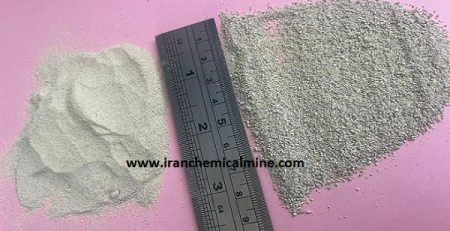
Fluorspar Grain Size and Particle Size
Fluorspar is commercially supplied in different particle sizes depending on the application.
There is no single universal particle-size specification for all grades.
Common Fluorspar Size Categories
| Product Form | Typical Description | Potential Applications |
|---|---|---|
| Lump | Coarse mineral pieces | Metallurgy, flux applications |
| Granular | Crushed and screened material | Metallurgy, industrial processes |
| Fine Powder | Ground fluorspar | Ceramics, welding, chemical applications |
| Fine Concentrate | Beneficiated fine material | Chemical processing |
| Micronized Powder | Very fine powder | Specialty industrial applications |
Typical mesh sizes may include 10–30 mesh, 20–80 mesh, 100 mesh, 200 mesh or other customized specifications, depending on the buyer.
For export orders, Iran Chemical Mine can discuss particle-size requirements according to the customer’s production process.
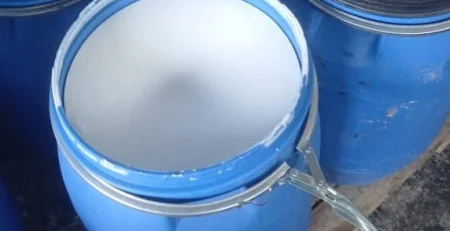
Fluorspar Packing for Export
Fluorspar packaging depends on grade, particle size, destination and customer handling requirements.
Common export packaging options include:
| Packing Type | Typical Weight | Suitable For |
|---|---|---|
| PP Bags | 25 kg | Powder and smaller industrial orders |
| PP/PE Bags | 25–50 kg | Industrial applications |
| Jumbo Bags | 500–1,500 kg | Bulk industrial consumption |
| Big Bags | 1 MT or customized | Large-volume industrial users |
| Bulk Shipment | According to logistics | Large-scale industrial buyers |
Export packing can be customized according to:
- container loading requirements
- destination regulations
- moisture protection requirements
- customer’s warehouse system
- automatic feeding systems
- palletization requirements
Fluorspar Export Destinations by Application
Different fluorspar grades are attractive to different industrial markets.
The following table provides a practical guide for exporters and buyers.
| Application | Preferred Grade | Potential Export Markets |
|---|---|---|
| Hydrofluoric Acid | Acid Grade ≥97% | India, China, South Korea, Japan, Europe |
| Fluorochemicals | Acid Grade | India, China, South Korea, Europe |
| Aluminum Industry | Acid / suitable metallurgical grades | India, Gulf countries, China, Turkey |
| Steelmaking | Metallurgical Grade | Turkey, India, Middle East, Southeast Asia |
| Ferroalloys | Metallurgical Grade | India, Turkey, Middle East, Asia |
| Glass | Ceramic Grade | Turkey, India, Middle East, Europe |
| Ceramics & Enamel | Ceramic Grade | Turkey, India, GCC, Europe |
| Welding Electrodes | Ceramic / selected grades | India, Turkey, Middle East, Southeast Asia |
| Specialty / Optical Uses | High Purity | Europe, Japan, South Korea, China |
These should be regarded as target market categories rather than guaranteed destinations. Actual export feasibility depends on current regulations, freight economics, sanctions/compliance requirements, buyer specifications and commercial terms.
Why Fluorspar Purity Matters
When purchasing fluorspar, CaF₂ percentage is only one part of the specification.
For example, an acid-grade buyer may require not only CaF₂ ≥97%, but also strict limits on:
- silica
- carbonate
- iron
- sulfur
- phosphorus
- arsenic
- moisture
- particle size
For metallurgy, a somewhat lower CaF₂ concentration may be commercially acceptable if the material provides the required fluxing performance at an economical cost.
Therefore, the best fluorspar grade is not necessarily the material with the highest CaF₂ content.
The correct grade is the grade that matches the process.
This is particularly important for international buyers because purchasing a higher-purity product than necessary can increase the cost without providing additional value to the end user.
Fluorspar Quality Control and COA
A professional fluorspar exporter should provide a Certificate of Analysis (COA) or technical specification for each commercial grade.
A typical COA may include:
| Parameter | Example Reporting |
|---|---|
| CaF₂ | % |
| SiO₂ | % |
| CaCO₃ | % |
| Fe₂O₃ | % |
| S | % |
| P | % |
| Moisture | % |
| Particle Size | Mesh / mm |
| Appearance | Color / physical form |
| Lot Number | Identification |
| Origin | Country / mine / processing source |
For specialized applications, buyers may request additional elements or compounds to be tested.
Iran Chemical Mine can work with buyers to establish a technical specification before shipment so that the supplied fluorspar is matched to the intended industrial application.
Global Fluorspar Market Outlook
The global fluorspar market continues to attract attention because fluorspar is an important upstream raw material for fluorine chemistry, metallurgy and several strategic industrial supply chains.
According to the U.S. Geological Survey’s 2026 Mineral Commodity Summaries, global mine production of fluorspar was estimated at approximately 10 million metric tons in 2025, with production estimated to have decreased by about 1% from the previous year. The USGS also reported continuing supply constraints in China and increasing Chinese imports during the first half of 2025.
The market is also experiencing increased interest in supply diversification. New or restarting mining and processing projects have been reported in countries including Canada, Australia, Germany, Italy, Kenya, Mongolia, Mozambique and the United States.
Increasing Importance of Acid Grade Fluorspar
Acid-grade fluorspar is strategically important because it feeds the hydrofluoric acid and broader fluorochemical value chain.
Demand from:
- refrigerants
- fluoropolymers
- aluminum fluoride
- specialty chemicals
- batteries
- electronics
- semiconductor-related industries
can support long-term demand for high-quality fluorspar.
Market research published in 2026 also points to continued importance of chemical applications and supply-security concerns surrounding acid-grade fluorspar.
Supply Diversification
China remains the dominant force in global fluorspar production and downstream fluorine chemistry, while Mexico, Mongolia, South Africa and Vietnam are also important sources.
The USGS reported that U.S. fluorspar import sources during 2021–2024 included Mexico, Vietnam, China and South Africa, demonstrating the international nature of the supply chain.
For industrial consumers, this environment makes reliable suppliers, consistent quality, transparent specifications and diversified sourcing increasingly important.
Fluorspar HS Code
Natural fluorspar is generally classified under HS Code 2529.
Common international classifications include:
| Product | HS Code |
|---|---|
| Fluorspar / fluorite, metallurgical grade | 2529.21 |
| Fluorspar / fluorite, acid grade | 2529.22 |
The exact customs classification should always be confirmed with the customs authority and the importer’s customs broker in the destination country.
The U.S. tariff schedule, for example, distinguishes metallurgical-grade fluorspar at 97% CaF₂ or less under 2529.21 and acid-grade material above 97% under 2529.22.
Fluorspar Supplier and Exporter from Iran
Iran Chemical Mine is an international supplier and exporter of Iranian industrial minerals and chemicals, serving buyers looking for competitive sources of raw materials for manufacturing and processing industries.
For fluorspar, our supply approach focuses on matching:
Grade → CaF₂ purity → impurity profile → particle size → packing → application → destination
rather than offering a one-size-fits-all product.
Iran Chemical Mine can discuss fluorspar supply for:
- Acid grade fluorspar
- Metallurgical grade fluorspar
- Ceramic grade fluorspar
- Fluorspar concentrate
- Fluorite powder
- Customized particle sizes
- Industrial bulk packing
- Containerized export shipments
Before placing an order, international buyers are encouraged to provide their required:
- CaF₂ percentage
- SiO₂ maximum
- CaCO₃ maximum
- Fe₂O₃ maximum
- sulfur and phosphorus limits, if applicable
- particle size
- packing requirement
- annual or monthly quantity
- destination port
This allows Iran Chemical Mine to identify and offer the most suitable fluorspar specification for the buyer’s application.
How to Choose the Right Fluorspar Grade
Choosing the correct fluorspar grade starts with the end application.
| If You Need Fluorspar For… | Recommended Starting Grade |
|---|---|
| Hydrofluoric acid | Acid Grade |
| Fluorochemicals | Acid Grade |
| Aluminum fluoride production | Acid Grade / specified chemical grade |
| Steelmaking flux | Metallurgical Grade |
| Ferroalloys | Metallurgical Grade |
| Glass | Ceramic Grade |
| Enamel | Ceramic Grade |
| Ceramics | Ceramic Grade |
| Welding electrodes | Ceramic / application-specific grade |
| Specialty high-purity applications | High-purity fluorite |
The final selection should always be based on the customer’s technical specification and COA requirements.
Frequently Asked Questions About Fluorspar
What is fluorspar?
Fluorspar is the commercial name for fluorite, a mineral primarily composed of calcium fluoride (CaF₂). It is an important source of fluorine and is also used as a flux in metallurgical processes.
Is fluorspar the same as fluorite?
Yes. Fluorite is the mineralogical name, while fluorspar is commonly used as the commercial and industrial term for bulk or processed fluorite.
What are the main grades of fluorspar?
The three principal industrial grades are acid grade, ceramic grade and metallurgical grade.
What is acid-grade fluorspar?
Acid-grade fluorspar generally contains 97% or more CaF₂ and is primarily used to manufacture hydrofluoric acid and fluorine-based chemicals.
What is metallurgical-grade fluorspar?
Metallurgical-grade fluorspar, or metspar, is used primarily as a flux in steelmaking, ferroalloys, aluminum and other metallurgical processes.
What is ceramic-grade fluorspar?
Ceramic-grade fluorspar is an intermediate-purity material, commonly around 85–96% CaF₂, used in selected glass, ceramic, enamel and welding applications.
What is the HS code for fluorspar?
Natural fluorspar is generally classified under HS 2529, with subheadings for metallurgical and acid grades.
Does Iran Chemical Mine export fluorspar?
Iran Chemical Mine supplies and exports fluorspar according to available material, customer specifications and international trade requirements. Buyers can request a quotation based on grade, CaF₂ content, particle size, packing, quantity and destination.
Conclusion
Fluorspar is much more than a simple mineral commodity. Its CaF₂ purity, impurity profile, particle size and physical form determine its suitability for different industrial applications.
The three major commercial categories—acid grade, ceramic grade and metallurgical grade fluorspar—serve distinctly different industries. Acid grade is particularly important for hydrofluoric acid and fluorochemical production, while ceramic grade serves glass, enamel and ceramic applications, and metallurgical grade is widely used as a flux in steelmaking and other metallurgical operations.
With continued demand from fluorochemicals, aluminum, metallurgy, specialty chemicals and advanced manufacturing, fluorspar remains an important raw material in global industrial supply chains.
For buyers seeking fluorspar from Iran, Iran Chemical Mine can provide sourcing and export solutions based on the required CaF₂ grade, chemical specification, particle size, packaging and destination market.
Contact Iran Chemical Mine for fluorspar supply, technical specifications and export quotations.