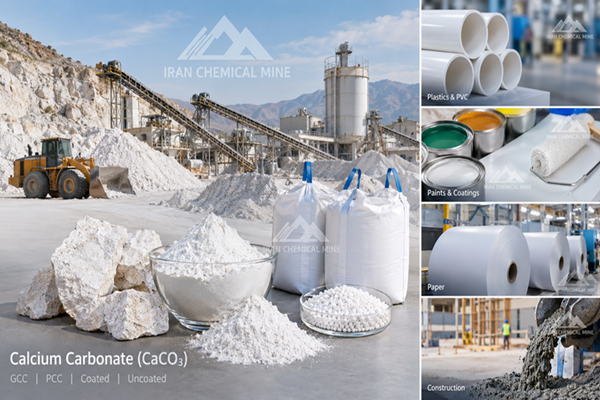
Calcium Carbonate (CaCO₃) Types, Production, Processing, Applications and Export Guide
Calcium Carbonate (CaCO₃) is one of the most widely used mineral materials in the world, serving as a functional filler, extender, pigment, mineral additive, and raw material across numerous industries. It is naturally present in limestone, calcite, chalk, and marble and can also be manufactured synthetically as Precipitated Calcium Carbonate (PCC).
Industrial Calcium Carbonate Powder is available in different grades, particle sizes, purities, surface treatments, and physical forms. The two main commercial categories are Ground Calcium Carbonate (GCC) and Precipitated Calcium Carbonate (PCC). GCC is produced by mechanically processing natural calcium carbonate minerals, while PCC is manufactured through a controlled chemical precipitation process.
Calcium Carbonate is also supplied as coated Calcium Carbonate and uncoated Calcium Carbonate. Coated grades are particularly important in plastics, masterbatch, PVC, rubber, cables, films, and other polymer-based products, while uncoated grades are widely used in paints, paper, construction materials, ceramics, adhesives, sealants, and numerous mineral-based applications.
Iran Chemical Mine supplies and exports industrial minerals and chemical raw materials, including Calcium Carbonate grades selected according to customer application, particle size, purity, surface treatment, packaging, and destination-market requirements.
What Is Calcium Carbonate (CaCO₃)?
Calcium Carbonate is an inorganic compound with the chemical formula CaCO₃. It is composed of calcium, carbon, and oxygen and occurs naturally in several important minerals and rocks.
The most common natural sources of Calcium Carbonate include:
- Limestone
- Calcite
- Marble
- Chalk
The quality of the original mineral has a major influence on the quality of the final Calcium Carbonate Powder. Factors such as calcium carbonate content, whiteness, brightness, moisture, iron content, magnesium content, particle-size distribution, and other impurities are important when selecting a grade for industrial applications.
Basic Calcium Carbonate Properties
| Property | Typical Description |
|---|---|
| Chemical formula | CaCO₃ |
| Molecular weight | 100.09 g/mol |
| Appearance | White or off-white powder |
| Main natural sources | Limestone, calcite, marble, chalk |
| Main industrial forms | GCC and PCC |
| Surface treatment | Coated or uncoated |
| Solubility in water | Very low |
| Main industrial role | Filler, extender, pigment, mineral additive |
| Common particle-size range | From coarse grades to micronized grades |
| Main applications | Plastics, paint, paper, rubber, construction, ceramics, adhesives and sealants |
Types of Calcium Carbonate
Industrial Calcium Carbonate can be classified according to its production method, mineral source, particle size, surface treatment, and application.
The two most important industrial categories are Ground Calcium Carbonate (GCC) and Precipitated Calcium Carbonate (PCC).
Ground Calcium Carbonate (GCC)
Ground Calcium Carbonate, commonly known as GCC, is produced by mechanically processing naturally occurring calcium carbonate minerals.
High-quality limestone, calcite, marble, or chalk is crushed, ground, classified, and processed into the required particle-size distribution.
GCC does not require a chemical conversion of calcium carbonate into another compound. The production process is primarily based on physical mineral processing.
Typical GCC Production Process
Mining → Crushing → Screening → Grinding → Classification → Separation → Surface Treatment (if required) → Packing
GCC can be manufactured in different particle sizes, ranging from relatively coarse industrial grades to very fine micronized Calcium Carbonate Powder.
Precipitated Calcium Carbonate (PCC)
Precipitated Calcium Carbonate, or PCC, is produced through a chemical manufacturing process rather than simply grinding natural limestone.
A common PCC production route involves producing calcium oxide from high-calcium limestone, hydrating it to calcium hydroxide, and then reacting the resulting suspension with carbon dioxide to precipitate Calcium Carbonate.
The controlled chemical process allows manufacturers to engineer characteristics such as particle size, morphology, surface area, and crystal structure.
GCC vs PCC: Comparison
| Feature | GCC | PCC |
|---|---|---|
| Full name | Ground Calcium Carbonate | Precipitated Calcium Carbonate |
| Source | Natural limestone, calcite, marble or chalk | Chemically produced |
| Production method | Crushing, grinding and classification | Chemical precipitation |
| Particle characteristics | Determined largely by mineral processing | Can be more precisely engineered |
| Particle morphology | Natural/mineral morphology | Controlled crystal morphology |
| Typical cost | Generally more economical | Generally higher |
| Main applications | Plastics, paint, rubber, paper, construction | Specialty paper, coatings, plastics, pharmaceuticals and specialty applications |
| Surface treatment | Available | Available depending on product |
| Main advantage | Cost-effective mineral filler | High control over particle characteristics |
Calcium Carbonate Processing and Production
The quality of Calcium Carbonate depends not only on the chemical composition of the raw material but also on the processing technology.
A professional Calcium Carbonate processing operation normally controls raw material selection, crushing, grinding, classification, powder collection, surface treatment, storage, and packaging.
Step 1: Selection of Raw Material
High-quality limestone, calcite, marble, or another calcium carbonate-rich mineral is selected according to the required final specification.
Important raw-material parameters include:
- CaCO₃ content
- Whiteness
- Brightness
- Iron content
- Magnesium content
- Silica content
- Moisture
- Mineral structure
- Hardness
- Contaminant level
Step 2: Crushing
Large pieces of limestone or calcite are reduced to smaller particles using appropriate crushing equipment.
The objective is to prepare the mineral for efficient grinding while maintaining consistent feed characteristics.
Step 3: Grinding
The crushed mineral is processed through grinding equipment to obtain the desired Calcium Carbonate Powder.
Depending on the final application, different milling technologies may be used.
The required fineness is determined by the customer’s application. Plastic masterbatch, PVC, paint, paper, rubber, construction materials, and ceramics may require different particle-size distributions.
Step 4: Classification
After grinding, the powder is classified according to particle size.
Air classifiers or other separation systems can be used to separate fine particles from coarser particles and return oversized material for additional grinding.
Particle-size distribution is one of the most important factors in determining Calcium Carbonate performance.
Step 5: Surface Treatment and Coating
For selected applications, especially polymer-based products, Calcium Carbonate can undergo surface treatment.
One of the most common approaches is treatment with stearic acid or a related surface modifier.
The purpose is to modify the surface characteristics of the mineral and improve its compatibility and dispersion within certain organic polymer systems.
Step 6: Quality Control
Before shipment, Calcium Carbonate should be tested according to the agreed specification.
Typical quality-control parameters include:
- CaCO₃ purity
- Whiteness
- Brightness
- Moisture
- Particle-size distribution
- D50
- D97
- Residue
- Oil absorption
- Bulk density
- pH
- Surface treatment level
- Iron and other impurities
Step 7: Packing and Storage
Calcium Carbonate is normally packed according to customer requirements and transportation conditions.
Common industrial packing options include:
- 25 kg bags
- 40 kg bags
- 50 kg bags
- 500 kg big bags
- 1,000 kg jumbo bags
- Customized bulk packaging
For export shipments, packaging should protect the Calcium Carbonate Powder against moisture, contamination, mechanical damage, and excessive compaction.
Coated Calcium Carbonate vs Uncoated Calcium Carbonate
One of the most important distinctions for industrial Calcium Carbonate buyers is whether the product is coated or uncoated.
Neither grade is universally better. The correct selection depends on the formulation and final application.
What Is Coated Calcium Carbonate?
Coated Calcium Carbonate is Calcium Carbonate whose particle surface has been treated with a surface modifier.
Stearic acid is commonly used for this purpose.
The treatment can modify surface energy, wettability, hydrophobicity, dispersion behavior, and compatibility with organic polymers.
What Is Uncoated Calcium Carbonate?
Uncoated Calcium Carbonate is supplied without an intentional organic surface coating.
It retains the natural mineral surface and is widely used where untreated Calcium Carbonate is compatible with the formulation.
Coated vs Uncoated Calcium Carbonate
| Parameter | Coated Calcium Carbonate | Uncoated Calcium Carbonate |
|---|---|---|
| Surface treatment | Yes | No intentional coating |
| Common treatment | Stearic acid or similar modifier | None |
| Surface behavior | More hydrophobic/oleophilic | More hydrophilic |
| Polymer compatibility | Generally improved for many systems | Depends on polymer/formulation |
| Typical applications | PVC, PE, PP, masterbatch, cables, rubber | Paint, paper, ceramics, construction |
| Dispersion in many polymers | Improved | Formulation dependent |
| Moisture interaction | Generally reduced surface wettability | Higher surface affinity for water |
| Typical market positioning | Functional filler for polymer systems | General mineral filler/extender |
When Should You Choose Coated Calcium Carbonate?
Coated Calcium Carbonate is commonly considered for:
- Plastic masterbatch
- PVC pipes and profiles
- PVC flooring
- Polyethylene products
- Polypropylene products
- Cable compounds
- Plastic films
- Raffia
- Rubber compounds
- Selected adhesives and sealants
- Polymer-based construction products
The precise coating level should be determined according to particle size, surface area, polymer type, filler loading, processing conditions, and final-product requirements.
When Should You Choose Uncoated Calcium Carbonate?
Uncoated Calcium Carbonate is widely considered for:
- Paints and coatings
- Paper and paperboard
- Construction materials
- Wall putty
- Ceramics
- Glass-related formulations
- Adhesives
- Sealants
- Some rubber products
- General mineral filler applications
Calcium Carbonate Particle Size and Grade Selection
Particle size has a significant influence on Calcium Carbonate performance.
Fine Calcium Carbonate Powder generally provides a greater surface area and can influence dispersion, opacity, surface finish, rheology, and filler performance.
However, finer is not automatically better.
The optimum particle size depends on the application.
Examples of Particle-Size Requirements
| Application | Typical Grade Preference | Important Parameters |
|---|---|---|
| PVC pipes | Fine coated GCC | Purity, coating, PSD, moisture |
| Plastic masterbatch | Fine coated GCC | PSD, coating, dispersion |
| Plastic film | Fine coated GCC | PSD, surface treatment, purity |
| Paint | Fine/medium uncoated GCC | Whiteness, brightness, PSD |
| Paper | Fine uncoated GCC/PCC | Brightness, PSD, purity |
| Rubber | Fine coated/uncoated GCC | Dispersion, PSD, oil absorption |
| Adhesives | Application dependent | PSD, moisture, oil absorption |
| Sealants | Fine GCC | Surface treatment, PSD |
| Ceramics | Selected uncoated grades | Purity and mineral chemistry |
| Construction | Medium/coarse grades | Cost, PSD, purity |
Main Applications of Calcium Carbonate
Calcium Carbonate is used across a broad range of industries because it can provide volume, whiteness, opacity, stiffness, dimensional control, processing benefits, and cost optimization.
Calcium Carbonate in Plastics
Calcium Carbonate is one of the most important mineral fillers used in plastics.
Coated Calcium Carbonate is particularly important for polymer systems such as:
- PE
- PP
- PVC
- EVA
- Masterbatch
- Cable compounds
- Plastic sheets
- Films
- Pipes
- Profiles
- Flooring
- Injection-molded products
Depending on formulation and loading level, Calcium Carbonate can help reduce formulation cost and modify mechanical, dimensional, processing, and surface characteristics.
Calcium Carbonate in PVC
PVC is one of the major markets for Calcium Carbonate.
Calcium Carbonate may be incorporated into:
- PVC pipes
- PVC profiles
- Cable compounds
- Flooring
- Sheets
- Artificial leather
- Construction products
Coated grades are frequently selected when improved interaction with the polymer matrix is required.
Calcium Carbonate in Paints and Coatings
Uncoated Calcium Carbonate is widely used as an extender and functional mineral filler in paints and coatings.
It can contribute to:
- Whiteness
- Opacity
- Filling capacity
- Surface properties
- Cost optimization
- Rheology control
Applications include:
- Interior paints
- Exterior paints
- Decorative coatings
- Primers
- Putty
- Powder coatings
- Industrial coatings
Calcium Carbonate in Paper
Calcium Carbonate is used as a filler and coating pigment in paper and paperboard production.
Important properties for paper applications include:
- Brightness
- Whiteness
- Particle size
- Particle-size distribution
- Purity
- Dispersion
- Optical performance
Both GCC and PCC can be used in paper applications, depending on the paper grade and required performance.
Calcium Carbonate in Rubber
Calcium Carbonate is used as a mineral filler in selected natural and synthetic rubber formulations.
It can contribute to:
- Filler volume
- Cost control
- Hardness modification
- Processing characteristics
- Surface finish
The appropriate choice between coated and uncoated Calcium Carbonate depends on the rubber compound and desired performance.
Calcium Carbonate in Adhesives and Sealants
Calcium Carbonate is commonly used as a mineral filler in adhesive and sealant formulations.
It may provide:
- Controlled viscosity
- Filler loading
- Cost optimization
- Body and consistency
- Dimensional stability
The correct grade depends on the resin, binder, plasticizer, curing system, and required rheological properties.
Calcium Carbonate in Construction
Calcium Carbonate is used in a variety of construction materials, including:
- Wall putty
- Dry-mix products
- Joint compounds
- Construction adhesives
- Sealants
- Mortars
- Decorative materials
Calcium Carbonate in Ceramics
Calcium Carbonate can be used as a raw material or mineral component in selected ceramic formulations.
The chemical composition and impurity profile are especially important because certain impurities can influence firing behavior and final ceramic properties.
Calcium Carbonate in Agriculture
Calcium carbonate-containing agricultural products can be used as calcium sources and, depending on the product and application, for soil pH management.
Agricultural Calcium Carbonate should be selected according to agricultural specifications rather than simply using an industrial filler grade.
Benefits and Advantages of Calcium Carbonate
Calcium Carbonate is popular in industrial formulations because of its combination of availability, functionality, versatility, and economic advantages.
Major Advantages
| Advantage | Industrial Benefit |
|---|---|
| High calcium carbonate content | Suitable for mineral filler applications |
| Natural mineral availability | Supports large-scale production |
| White appearance | Useful in white and light-colored products |
| Multiple particle sizes | Allows application-specific formulation |
| Coated grades available | Better compatibility with many polymers |
| Uncoated grades available | Suitable for mineral and water-based systems |
| Cost-effective filler | Can optimize formulation cost |
| Versatile functionality | Used across many industries |
| GCC availability | Suitable for large-volume industrial applications |
| PCC availability | Enables engineered particle characteristics |
Calcium Carbonate as a Cost-Optimization Filler
One of the major commercial reasons for using Calcium Carbonate is its ability to replace part of a more expensive formulation component in certain products while maintaining the required properties.
However, the optimum filler loading must be established through formulation trials.
Excessive filler loading or inappropriate particle size can negatively affect mechanical properties, processing, surface quality, or dispersion.
Calcium Carbonate for Different Industries
| Industry | Typical Calcium Carbonate Type | Main Purpose |
|---|---|---|
| Plastics | Coated GCC | Functional filler |
| Masterbatch | Coated GCC | Mineral filler and formulation optimization |
| PVC | Coated GCC | Filler and processing support |
| Cable | Coated GCC | Filler in polymer compounds |
| Plastic film | Fine coated GCC | Filler and controlled film properties |
| Paint | Uncoated GCC | Extender and filler |
| Paper | GCC/PCC | Filler and coating pigment |
| Rubber | Coated/Uncoated GCC | Mineral filler |
| Adhesives | GCC | Filler and rheology control |
| Sealants | GCC | Filler and consistency control |
| Construction | Uncoated GCC | Mineral filler |
| Ceramics | Selected GCC | Raw material/mineral component |
| Agriculture | Agricultural-grade CaCO₃ | Calcium and soil applications |
Calcium Carbonate Export Markets by Application
The international market for Calcium Carbonate is diverse because demand exists across plastics, paints, paper, rubber, construction, ceramics, and other manufacturing industries.
For exporters, the appropriate destination should be selected according to the customer’s industry, required grade, logistics, particle size, packaging, and technical specifications.
The following table provides a market-development guide rather than a ranking of countries by current import volume.
| Application | Potential Export Destinations | Preferred Product Consideration |
|---|---|---|
| PVC and plastics | Turkey, Egypt, UAE, Saudi Arabia, Iraq, Pakistan, India | Fine coated GCC |
| Masterbatch | Turkey, UAE, India, Egypt, Saudi Arabia | Fine coated GCC |
| Plastic film | Turkey, UAE, East Africa, South Asia | Fine coated GCC |
| Paints & coatings | Iraq, UAE, Oman, Saudi Arabia, East Africa, Turkey | Uncoated GCC |
| Paper | Turkey, India, UAE, Egypt, Pakistan | Fine GCC/PCC |
| Rubber | Turkey, India, UAE, Egypt, East Africa | Coated or uncoated GCC |
| Construction | Iraq, Afghanistan, Central Asia, GCC, East Africa | Medium/fine uncoated GCC |
| Adhesives & sealants | UAE, Turkey, Saudi Arabia, Iraq, East Africa | Fine GCC |
| Ceramics | Turkey, UAE, India, Iraq, Central Asia | High-purity uncoated GCC |
| Agriculture | Iraq, Central Asia, East Africa, South Asia | Agricultural-grade CaCO₃ |
Calcium Carbonate Export Opportunities in Africa
Africa represents a potential market for Calcium Carbonate because of demand from construction, paint, plastics, PVC, rubber, adhesives, and other manufacturing industries.
Potential markets include:
- Tanzania
- Kenya
- Uganda
- Ethiopia
- Egypt
- Nigeria
- Ghana
- South Africa
- Algeria
- Morocco
For African customers, exporters should consider both technical requirements and logistics. Bulk industrial orders may favor jumbo bags, while smaller distributors may require 25 kg or 50 kg bags.
Calcium Carbonate Export Opportunities in the Middle East
The Middle East has established manufacturing sectors using mineral fillers in plastics, PVC, paints, construction products, paper, adhesives, and sealants.
Potential markets include:
- UAE
- Saudi Arabia
- Oman
- Qatar
- Iraq
- Kuwait
- Jordan
The UAE can also serve as a regional trading and distribution hub for Calcium Carbonate and other industrial minerals.
Calcium Carbonate Export Opportunities in South Asia
South Asian manufacturing industries use Calcium Carbonate in plastics, masterbatch, PVC, paper, rubber, paints, and construction-related products.
Potential markets include:
- India
- Pakistan
- Bangladesh
- Sri Lanka
For these markets, product consistency, particle-size distribution, packaging, technical documentation, and competitive delivered cost are particularly important.
Calcium Carbonate Export Opportunities in Europe and Türkiye
Türkiye and selected European markets have significant manufacturing activity in plastics, paints, rubber, paper, ceramics, and construction materials.
For European buyers, exporters should pay particular attention to:
- Consistent quality
- Product documentation
- Safety Data Sheet
- Technical Data Sheet
- Certificate of Analysis
- Packaging standards
- Regulatory requirements
- Traceability
How to Select the Right Calcium Carbonate Grade
The correct Calcium Carbonate should be selected based on the application rather than price alone.
Before purchasing Calcium Carbonate Powder, buyers should specify:
Chemical Requirements
- CaCO₃ percentage
- MgO
- SiO₂
- Fe₂O₃
- Moisture
- Acid insoluble matter
- Other impurities
Physical Requirements
- Whiteness
- Brightness
- Particle size
- D50
- D97
- Residue
- Bulk density
- Oil absorption
- pH
Surface Requirements
For coated Calcium Carbonate:
- Coating material
- Coating percentage
- Surface-treatment method
- Activation level
- Moisture
- Dispersion characteristics
Packaging Requirements
- 25 kg bags
- 50 kg bags
- Jumbo bags
- Customized packaging
- Palletized shipment
- Container loading requirements
Calcium Carbonate Quality Control for Export
A reliable Calcium Carbonate supplier should be able to provide technical information and quality documentation corresponding to the supplied grade.
Typical export documentation may include:
- Commercial Invoice
- Packing List
- Certificate of Origin
- Certificate of Analysis (COA)
- Technical Data Sheet (TDS)
- Safety Data Sheet (SDS)
- Bill of Lading
- Inspection documents when required
For long-term industrial customers, consistency from shipment to shipment is often as important as the nominal specification.
Calcium Carbonate Packaging for International Shipping
Calcium Carbonate Powder is commonly exported in bags or jumbo bags.
25 kg Bags
Suitable for:
- Distributors
- Smaller industrial users
- Paint manufacturers
- Adhesive manufacturers
- Specialty applications
50 kg Bags
Suitable for customers requiring larger individual units while maintaining conventional manual or mechanical handling.
Jumbo Bags
500 kg and 1,000 kg jumbo bags are commonly considered for large-volume industrial customers.
They can be particularly suitable for:
- Plastics manufacturers
- Masterbatch plants
- Construction-material producers
- Large paint factories
- Rubber manufacturers
Packaging can be customized according to customer requirements and container-loading arrangements.
Why Buy Calcium Carbonate from Iran Chemical Mine?
Iran Chemical Mine is an export-oriented supplier of industrial chemicals and minerals serving international B2B customers.
For Calcium Carbonate, the supply process can be organized according to the customer’s:
- Required CaCO₃ purity
- Coated or uncoated requirement
- Particle-size specification
- Application
- Packaging
- Quantity
- Destination country
- Shipping requirements
Our approach is based on matching the Calcium Carbonate grade to the customer’s actual manufacturing application rather than supplying a generic powder without considering its end use.
Iran Chemical Mine Calcium Carbonate Supply Options
| Requirement | Available Consideration |
|---|---|
| Product | Calcium Carbonate CaCO₃ |
| Type | GCC / application-specific grades |
| Surface | Coated / uncoated |
| Particle size | Application-specific |
| Packaging | 25 kg / 50 kg / jumbo bags |
| Market | International B2B export |
| Documentation | COA / TDS / SDS and export documents as required |
| Applications | Plastics, PVC, paint, paper, rubber, construction, adhesives and more |
For buyers requiring a specific specification, Iran Chemical Mine can evaluate the required CaCO₃ purity, particle size, coating, whiteness, packaging, quantity and destination before quotation.
Calcium Carbonate: GCC, PCC, Coated or Uncoated?
Choosing the correct type of Calcium Carbonate depends primarily on the final product.
| Requirement | Recommended Direction |
|---|---|
| General industrial filler | GCC |
| Large-volume economical filler | GCC |
| Polymer compatibility | Coated GCC |
| Plastic masterbatch | Fine coated GCC |
| PVC | Coated GCC |
| Paint | Uncoated GCC |
| Paper | GCC or PCC depending on specification |
| Specialty particle morphology | PCC |
| Rubber | Coated or uncoated GCC depending on formulation |
| Construction | Uncoated GCC |
| Adhesives | Grade selected according to formulation |
| Sealants | Fine GCC, coated or uncoated according to system |
| Specialty applications | PCC or specially processed GCC |
Frequently Asked Questions About Calcium Carbonate
What is Calcium Carbonate?
Calcium Carbonate is an inorganic mineral compound with the chemical formula CaCO₃. It occurs naturally in limestone, calcite, marble, and chalk and is widely used as an industrial filler, extender, pigment, and mineral additive.
What is Ground Calcium Carbonate?
Ground Calcium Carbonate, or GCC, is produced by mechanically crushing, grinding, and classifying natural calcium carbonate-rich minerals such as limestone, calcite, marble, or chalk.
What is Precipitated Calcium Carbonate?
Precipitated Calcium Carbonate, or PCC, is manufactured through a controlled chemical precipitation process. PCC allows greater control over particle characteristics and crystal morphology than conventional mechanically ground GCC.
What is the difference between coated and uncoated Calcium Carbonate?
Coated Calcium Carbonate has been surface-treated, commonly with stearic acid, to modify its surface characteristics and improve compatibility with many organic polymer systems. Uncoated Calcium Carbonate does not have an intentional organic surface coating.
Is coated Calcium Carbonate better than uncoated Calcium Carbonate?
Neither is universally better. Coated Calcium Carbonate is generally considered for polymer-rich applications such as plastics, PVC, masterbatch, and some rubber products, while uncoated Calcium Carbonate is widely used in paints, paper, construction materials, ceramics, and other mineral-based systems.
What industries use Calcium Carbonate?
Major industries include plastics, PVC, masterbatch, paint, coatings, paper, rubber, adhesives, sealants, construction materials, ceramics, agriculture, and selected specialty applications.
What is the most important specification when buying Calcium Carbonate?
There is no single specification that is most important for every application. CaCO₃ purity, particle size, particle-size distribution, whiteness, moisture, oil absorption, surface treatment, and impurity levels should be considered according to the final application.
Can Calcium Carbonate be exported in jumbo bags?
Yes. Calcium Carbonate can be supplied in jumbo bags, commonly for large-volume industrial customers. Exact bag weight and construction should be agreed according to customer handling and shipping requirements.
Does finer Calcium Carbonate always provide better performance?
No. The optimum particle size depends on the application. Extremely fine particles can increase surface area and influence binder demand, dispersion, rheology, and processing. The correct particle-size distribution should therefore be selected based on the customer’s formulation.
How can I order Calcium Carbonate from Iran Chemical Mine?
Send Iran Chemical Mine your required application, CaCO₃ purity, coated or uncoated requirement, particle size, quantity, packaging, and destination country. These details allow the appropriate Calcium Carbonate grade and export specification to be evaluated.
At the end
Calcium Carbonate (CaCO₃) is a highly versatile industrial mineral available in different grades and forms, including Ground Calcium Carbonate (GCC), Precipitated Calcium Carbonate (PCC), coated Calcium Carbonate, and uncoated Calcium Carbonate.
Its applications extend from plastics, PVC and masterbatch to paints, paper, rubber, adhesives, sealants, construction materials, ceramics, agriculture, and specialty products.
The selection of the right Calcium Carbonate should be based on the final application, purity, particle-size distribution, whiteness, moisture, surface treatment, packaging, and technical requirements.
For international buyers seeking a reliable source of Calcium Carbonate and other industrial minerals, Iran Chemical Mine provides export-oriented sourcing and supply solutions with product specifications adapted to customer requirements and destination markets.
Contact Iran Chemical Mine for Calcium Carbonate Powder, coated and uncoated Calcium Carbonate, GCC grades, technical specifications, packaging options and international export inquiries.